 |
|
Source: Larry Kim
Talk to us about digital marketing.
Call us FREE from mobiles and landlines on 0800 044 3664 and speak with one of our digital marketing experts to request more information or schedule a meeting.
Internet Marketing Team
Source: Larry Kim
Call us FREE from mobiles and landlines on 0800 044 3664 and speak with one of our digital marketing experts to request more information or schedule a meeting.

If you are trying to digitally market your business, whether that is to other businesses or to the end consumer, then you are going to want to make sure that you know the best new trends that are happening right now as well as what is coming up in the future.
To help you, we have put together our guide to the top marketing trends that you need to know about during 2019.
It is no secret that we all rely on voice searches much more than we ever thought that we would. This means that the way that businesses think about their keywords needs to change. Rather than being stale and relying on simple keywords on their own, the idea now is thinking about things from a much more conversational approach, as if someone is asking a question rather than typing in a keyword search. Chatbots are very useful and popular and constantly being refined.
Ikea was one of the first mainstream companies to adopt a chatbot when they launched a virtual assistant called Anna in 2005. Customers ask Anna a wide range of questions from opening hours and prices to items of stock and hot dogs. Ten years after they released Anna she was shut down due to poor customer feedback. In hindsight maybe they were premature in shutting Anna down – it was just as chatbots were being picked up more broadly and taking leaps in functionality and refinement.
Conversational commerce is becoming more integral to digital marketing now as it enables consumers to provide feedback, make suggestions and help ease the shopping process. This isn’t something new – commerce has always been a conversational process it’s just we used to do it face to face and ask questions to real people. E-commerce has moved away from this over the years and we now see the trend moving back towards offering more of a conversational service but delivered in a slicker more effortless manner.
The thing about digital marketing is that it can be all too easy to think about making sales, gathering clients and essentially working on your ROI. Of course, this is incredibly important to keep in mind, but you should never discount how vital it is to create brand loyalty, create brand understanding and of course create a demand for your product or service too. You need to think about digital marketing as a whole, you need to set goals for each segment of marketing and work on it as best that you can. By setting up your digital strategy in this way you break each micro strategy down and assess what it is trying to achieve and the end success or failure as opposed to putting it all together and working out one headline ROI that masks some super successes and failures.
Amazon is a giant in the retail world and for many companies, there really is no choice but to get on board their train. Whilst this may help you to get sales, the trouble with Amazon is that it can be hard to get repeat buyers, especially those that go through you directly. Think about how you can make your brand strong. You need to focus on the lifetime value of a sale/ new customer and encourage them to come back directly to you and not via Amazon swerving the commission you would pay on repeat sales. Use Amazon and the Amazon Advertising campaign suite to your advantage, and you should go far.
Whilst mobile searching is still a part of marketing that you need to think about, it isn’t quite growing as fast as you may hope. That said, one part of searching on Google that is seeing some increase in use is YouTube. This platform has been one that you should keep on your radar for a while now, so, if you really want to be seen, then you are going to need to embrace YouTube and get yourself on there as soon as possible.
You might think that you need to have a campaign for each platform that you use to market on, however, the truth is, as things are changing so is this. Campaigns are now able to move across a number of platforms, still targeting your specific audience and making sure that they are who you reach. Whether that is on YouTube, Facebook or perhaps just your standard Google search.
We are expecting the rollout of new campaigns that will enable you to target specific audiences across a range of categories and services. So, to give you an example you will be able to roll a remarketing campaign across a specific audience covering YouTube, Play Store, Search and Display networks. It will make the whole process more streamlined and easier to manage driving revenue growth on Google as both mobile and desktop even off.
There has been plenty in the media of late about security breaches and issues with data on Facebook, which has meant that some people have decided to limit their use of the app. In fact, more people are dropping off than signing up. That said, you should never discount just what Facebook can do for your business. It is still an incredibly useful platform and one that can help you to get your reach and build a network. Facebook Ads is going from strength to strength – last year just under 30% of all digital spending in Europe was made through Facebook and they plan to grow this share. Facebook has expanded its opportunities to advertise across its ecosystem. Currently the company has a reach across Facebook, Instagram, Audience Network and Messenger. Next year WhatsApp is being added to the stable of digital advertising channels on offer and we think it’s going to be a great addition.
One thing that hasn’t quite come into power at the moment, but that is on its way, are automated campaigns. These are likely to make an appearance in the next 12 months. It will start with Google; of course, however, it won’t be long until other platforms are also going to take this on, which means that you need to think about how this is going to work for you. The goal here is to make it simpler and encourage more small to medium business to jump on board.
As you can see, there are plenty of things to look forward to if you are thinking about marketing in 2019. Why not take a deeper look at what is coming up and see how you can make them work for you? Better still speak to one of our award winning team who will be happy to discuss which channels your company should be leveraging and what strategy should be deployed.
Call us FREE from mobiles and landlines on 0800 044 3664 and speak with one of our digital marketing experts to request more information or schedule a meeting.

It is no secret that when it comes to marketing powerhouses, Google is the search engine of choice for many. However, that doesn’t mean that it is the only one. There is a wealth of other search engines out there that you can take a look at and which one you use will really have something to do with your age.
A study carried out by Further during 2015 showed that those aged 45-64 were most likely to use Bing, whilst for those that were over the age of 65, Yahoo!, was the go-to search engine.
Which answers the question that so many of us in the know may ask, “does anyone use Yahoo anymore?”
In comparison, those who were aged 25-34 (who most used Google for their search needs) were not fans of Bing, whilst those who were aged over 65+ were not fans of using Google.
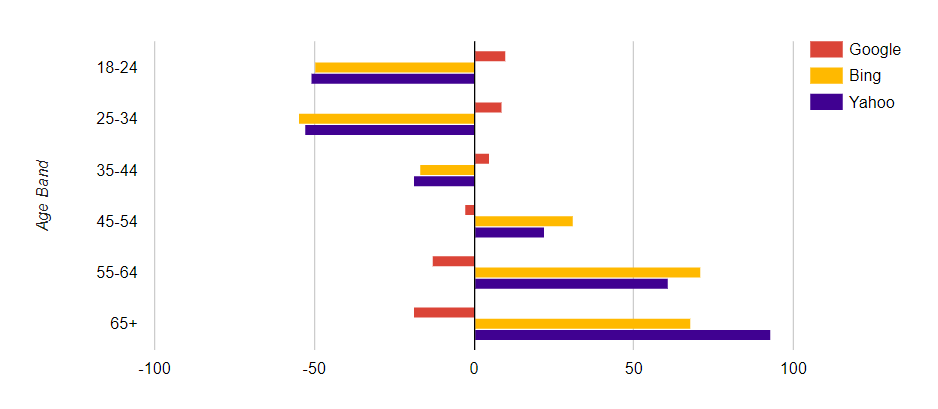
The above graph, courtesy of Further, shows that there is a definite link between the age of a person and how they use search engines. The positive scores show where they are most likely to use a search engine and the negative shows where they are less likely to use it.
Yet more research has been completed into this, with comScore carrying out their own review during 2015. This showed that Bing was definitely the search engine favoured by older users. Those who used Bing were at least 35 years old, most commonly within the 55-64 bracket, whilst their children, who fell into the younger age bracket, would be the ones to use Google.
One thing to bear in mind when considering running PPC ads (pay per click) on Yahoo/ Bing (YB) ad is that they are spread over three different networks
1. Bing
2. Yahoo
3. AOL
So the reach of a campaign you are running may well be wider than at first thought.
Compared to Google the search volume on Bing is TBH small. Google accounts for just over 92% of all searches with Yahoo / Bing pulling in 6%. That said the user demographic and audience profile may be much aligned with your niche and therefore may deliver a higher conversion % than Google.
As we see above the core users are being between 55 and 64. What we also know is the average household incomes of a Bing users is £58,000+ or more. Taking these two statistics alone we know that your target market is in the older end of the scale and your product is a higher price point then Bing ads could be a route to add to your marketing mix.
To back up this Bing said recently that the audience on the Microsoft Search Network spends typically 38% more when they shop online in comparison to the average internet user as well as have a measurably greater intent to purchase due to the higher levels of disposable income.
Some headline YB stats that are interesting to note are:
– The split between men and women is equal 50/50
– 46% of the users are married
– 32% of Yahoo/ Bing users have kids
– 38% are University graduates
– 96% of users across the Bing network have been into an ecomm shop in the past month
– 10% of the user identify themselves as LGBTQ
One of the newest introductions to the world of search engines has to be voice searching. However, it definitely seems that there is an age bracket preference on this particular approach to searching for what you need.
Google carried out a survey in 2014, looking at 1,400 smartphones in the US and how often voice searches were used on those smartphones. The usage of voice searches was the highest in those aged between 13-18 and of those teens over half of them said that they used voice searches more than once a day. Teenagers were also much keener to use voice searches with their friends or other company with 57% happy to do this in public, this compared to the 24% of adults who would be willing to search in public.
The amount that adults used voice searches was at a much lower rate than teenagers, however, at least 41% of those adults who used voice searches said they did so multiple times each and every day.
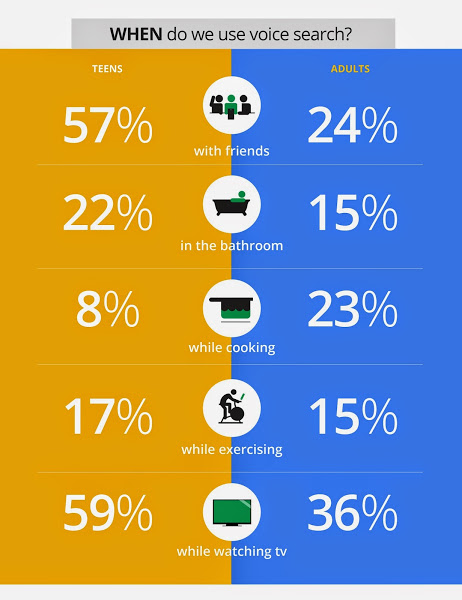
It makes sense that your age will affect how you use your mobile phone and the internet in general, however, it is interesting to see that your age actually has a much bigger impact on what you do then you may realise.
Call us FREE from mobiles and landlines on 0800 044 3664 and speak with one of our digital marketing experts to request more information or schedule a meeting.

As CPCs rise, proper Shopping campaign setup becomes that much more important. This setup involves segmentations around various product types, brand and products. On the feed side, it means ensuring all products have clear titles, descriptions, and images with all categories being classified correctly according to Google’s specifications. But there is another component to Google Shopping that is just as important.
Often neglected in Google Shopping management is the actual optimisation side of things. Though Shopping campaigns lack traditional keyword targeting and standard text ads, they still require ongoing updates. In this post we will detail five ways in which you can effectively optimise your Shopping campaigns to improve performance.
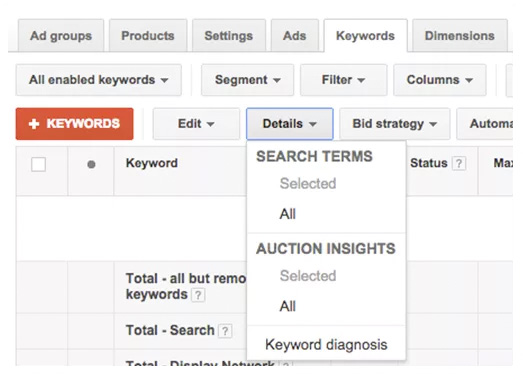
Though Shopping campaigns don’t include keywords for which you bid, PLAs are triggered by search queries. You can view these search queries in the “Dimensions” tab under “View: Search terms” or in the “Keywords” tab by clicking “Details” and then “Search Term > All.” We prefer to review search queries directly within the “Keywords” tab, as we’re able to exclude directly from this interface.
Once we have the queries we’ll set up a filter to view poor performing terms. The filter can be set to your desired preference. We first look at queries that haven’t converted but have seen at least 50 clicks over the last 60 – 90 days.
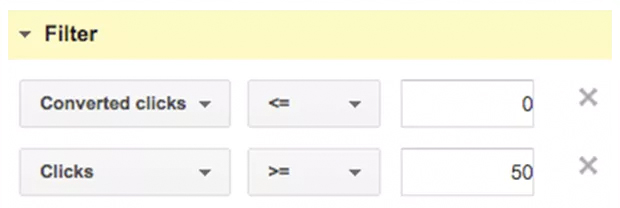
We’ll also look at queries with the highest cost per conversions and/or lowest conversion rates. For example, we’re likely to exclude a query that has seen 100 clicks and only 1 conversion with a cost per conversion of £100. We may then leave a query that has seen 300 clicks with only 5 conversions at a cost per conversion of £50. Determining when to exclude a query can be subjective so it’s important to analyse in conjunction with your account goals.
When excluding queries you’ll also want to pay attention to your Search Funnels report. This report shows how your keywords and campaigns are working together to produce conversions. For example, a click on a PLA might have been the first click, but the user left the site and then clicked a branded ad and ultimately converted. Unfortunately, you can’t see which query assisted, but you can see that a Shopping campaign helped.
Just like search queries, you can see individual product performance within the “Dimensions” tab.
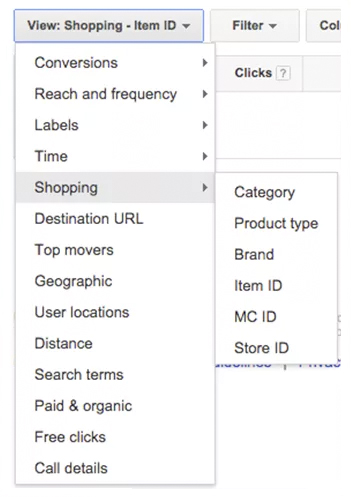
You can easily see which products are producing conversions at acceptable rates and which are not. For products that are performing well you can bid higher within the Shopping campaign that they are housed. Within the appropriate product group you can subdivide by item ID and set a higher bid.
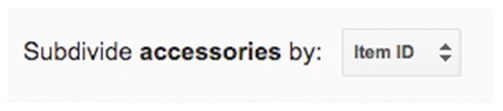
In this example, the specific item ID may get a £1 bid while the accessories product group may continue with a £0.85 bid. Recognising that the specific product performs better, you are giving it more exposure with a higher bid.
Conversely, you can lower bids on products that aren’t performing or exclude all together. We’ve also created poor performers campaigns that house these ineffective products. The idea is that we’ll exclude these products in our regular Shopping campaigns and relegate to a campaign with a much lower bid.
You can also view performance by brand utilising the “Brand” report in the “Dimensions” tab. Just like individual products, you can see which brands perform better or worse. The goal is to subdivide your product group by the specific brand. For example, if you are selling socks you may only want to bid on the Nike brand because it has the highest profit margin. You would then exclude everything else in that accessories product group. Thus, any “sock” related search would produce a PLA containing a Nike product.
We’ve found that dayparting and geotargeting are two optimisation techniques that are easy to do, but often forgotten. We don’t know if it’s a misconception that these techniques aren’t applicable to Shopping campaigns, but they can pay huge dividends.
After we accrue enough data (again, subjective based upon your goals and industry), we will set my time and geo modifiers. Unfortunately, these modifiers can’t be set at the ad group level (like in standard Search and Display campaigns). We may find that cost per conversion is too high during the hours of 1 AM – 6 AM, thus eliciting a substantial negative bid modifier. After setting the modifiers, continue to review at least once a month for additional opportunities.
Admittedly, optimising the feed can be difficult, but is well worth it in the long run. As stated earlier, Shopping campaigns don’t utilise keywords so Google pulls the most relevant product based upon the feed details. If we’re searching for an oval coffee table, Google is going to show a PLA from my feed based upon the product that best matches this query. We want to make sure that product is the right one.
Similar to SEO page titles and meta descriptions, product titles and descriptions should be written with the targeted keyword(s) in mind. The “keyword research” for potential titles and descriptions can come from:
Having shared these sources, you’ll want to make sure that you still include the product name in the title and description.
Another technique is to ensure that product images are enticing to click. Often retailers will use the standard manufacturer’s image. We suggest having a professional photographer take photos of all products for better quality. We realise that a Shopping “photo shoot” isn’t always in the budget, but we would encourage retailers to do what they can to make the product images stand out.
There is much to be done with Shopping campaigns beyond the initial setup. Just like standard Search and Display campaigns, it’s not “set it and forget it.” Make sure you are utilising optimisation tactics to continue improving performance.
Call us FREE from mobiles and landlines on 0800 044 3664 and speak with one of our digital marketing experts to request more information or schedule a meeting.

What we have recently come to understand is that bottom line performance does not tell the entire story. As users become more sophisticated in their searching patterns, the path from initial search to conversion is growing longer. This conversion path is called a ‘search funnel’.
Understanding an account’s conversion path will help you make more informed optimisations and overall account management decisions. Quite often, your underperforming keywords could be indirectly helping other keywords in the account to convert. Pausing an underperforming keyword that drives conversions in another area of the account will ultimately hurt overall volume and profitability.
Today we will dive into the search funnel report and discuss how to best use it, so you can better understand what comprises the conversion path.
The search funnel report documents a searcher’s entire path to conversion. Sometimes the path is just one query long. Other times it’s an entire series of keywords and queries.
Search funnel data can be found in three locations:
Interpreting the search funnel report can seem daunting. There are dozens of mini reports and filters that show search funnel activity in a variety of ways. We’ve provided simple definitions to help make it easier to remember what the report’s key fields mean.
Assisted Clicks: Clicks on keywords that led to a conversion on a different keyword.
Assisted Impressions: Impressions that led to other impressions that led to a conversion.
First/Last Click Analysis: Keyword performance at the beginning or end of the conversion path.
Click Assisted Conversions: Total number of conversions a keyword contributed to by having assisted clicks.
Top Paths: The actual path searchers took that led to a conversion.
Path Length: The amount of clicks it took until a conversion occurred.
Attribution Modelling: What marketing channel got credit for the conversion?
Search funnel data is collected via conversion tracking. If conversion tracking is already installed, no additional set up is required. If tracking isn’t installed, all you have to do is create a conversion pixel and install it per Google’s directions. For more information on setting up conversion tracking, just visit Google’s help center.
Now that we have a basic understanding of what the search funnel report, the next question is:
We use search funnel reports to communicate value to our clients, and to better understand user behaviour. For instance, when it’s time to decide where to increase or pull back spend, we can justify keeping keywords live that might normally get paused if we were looking exclusively at the bottom line data.
Below is a sample keyword report that we pulled from the Google interface. All we did was add assisted clicks, click assisted conversions, assisted impressions, & impression assisted conversions.

The cost per converted click for ‘nursing associates program’ is £389. Based on that bottom line cost, we wouldn’t want to continue on with that keyword. However, there is 1 impression assisted click. Whether you value your assisted conversions equally as last click conversions or not, this extra conversion means the keyword is performing much closer to goal and is worth keeping live.
On the other hand, the 2nd keyword, ‘nurse degrees’ has only 1 conversion at a £327 cost per converted click, and it has 0 assisted clicks, conversions, or impressions. In this instance, we can be reasonably assured this keyword is not producing any conversions and is only running up cost, and can therefore be paused.
Below is an example of user behaviour. We’re particularly interested in this query path. Notice the progression from a general interest search (‘degree in dental hygiene’), to a more targeted search (‘dental hygienist schools’), and finally to a specific search (‘dental hygienist schools Georgia’).

From this simple view, we’ve learned 2 things:
We also learned we need to fill any keywords gaps by making sure my list contains keywords that mirror the conversion path our prospects are taking.
Call us FREE from mobiles and landlines on 0800 044 3664 and speak with one of our digital marketing experts to request more information or schedule a meeting.
